EPDM, Felt, Fibreglass or GRP: Which Flat Roof Material Lasts Longest?
By the Professional Roofers team
Updated 2026 · Independent cost guide
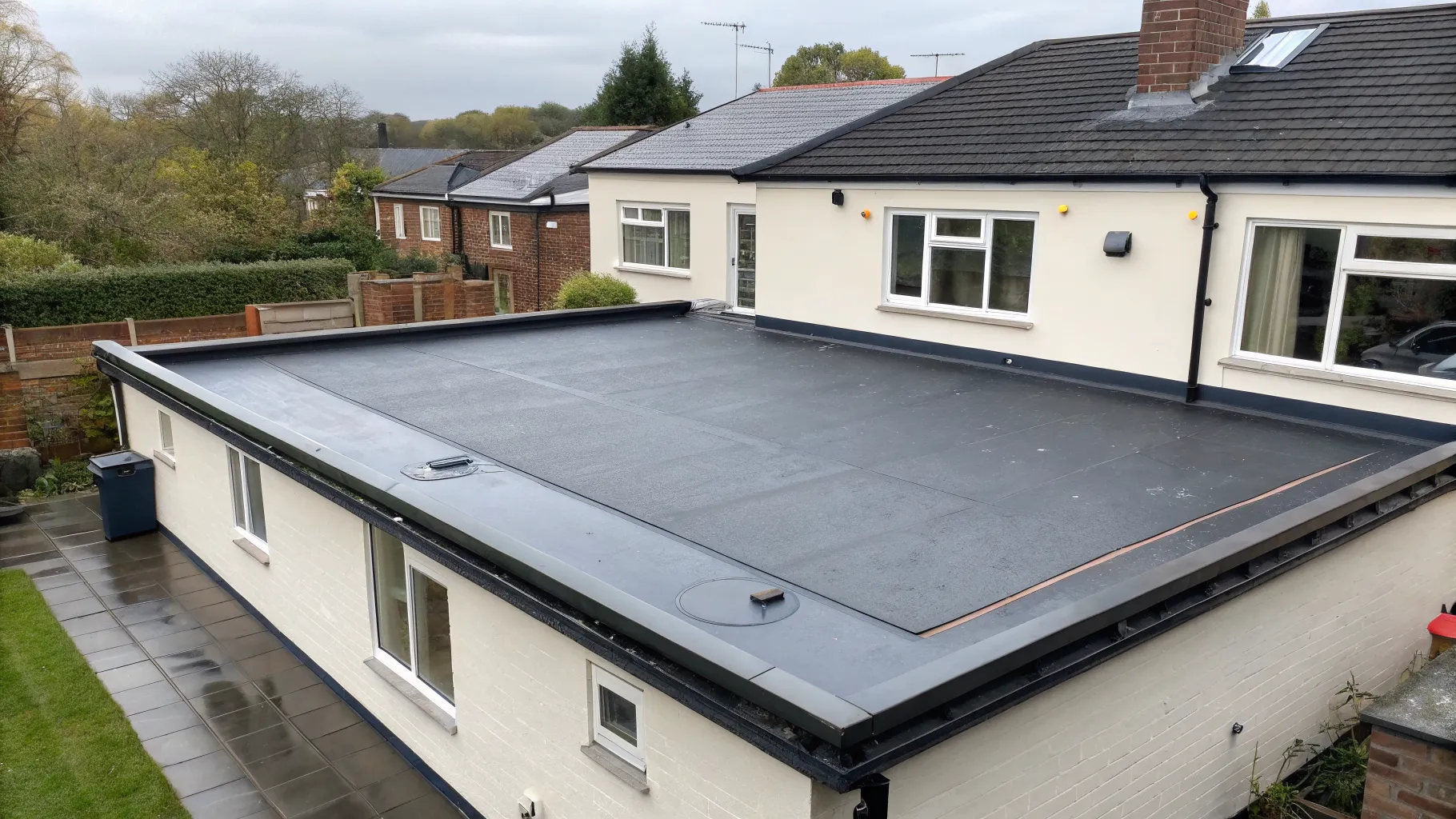
If you are staring at a tired flat roof over an extension, garage or dormer, the first decision is not which roofer to call. It is which material you want on top. Get that right and the quotes you collect become easy to compare. Get it wrong and you can pay for a covering that fails a decade early, or spend extra on a system the roof never needed.
There are four serious options for a domestic flat roof in the UK: traditional felt, EPDM rubber, fibreglass (GRP), and the high performance felts that sit between them. Each behaves differently in our wet, freeze and thaw climate. Here is how they compare on lifespan, cost and the ways they fail.
The four materials, in plain terms
Felt is the traditional layered system. Strips of bitumen impregnated felt are bonded together, either with hot bitumen or, more commonly now, melted on with a gas torch (called torch on felt), then finished with a mineral surface or stone chippings. It is the cheapest mainstream option and the one most people picture when they think of an old, blistered flat roof.
EPDM is a synthetic rubber membrane. On a domestic roof it usually arrives as a single large sheet cut to fit, then bonded to the deck with adhesive. Because it is one piece on most small roofs, there are very few joints to fail. It is the system you will hear roofers call a “rubber roof”.
Fibreglass, or GRP, stands for glass reinforced plastic. A roofer lays fibreglass matting over a board deck, then saturates it with liquid resin and a coloured topcoat. It cures into a hard, jointless shell you can walk on. It is the same family of material used for boat hulls.
High performance felt is a modern, polymer modified version of traditional felt. It costs more than basic felt and lasts noticeably longer, a fair middle ground rather than a separate category.
How long each one actually lasts
This matters most, because the cheapest roof per square metre is rarely the cheapest roof over twenty years.
- EPDM rubber: typically 25 to 50 years when correctly installed. The membrane is very stable in sunlight, and good installs regularly pass 30 years without major work.
- Fibreglass (GRP): around 25 to 30 years for the structure, but the coloured topcoat that protects it from UV usually needs recoating somewhere between 10 and 20 years in to keep it watertight.
- Torch on and high performance felt: 15 to 30 years depending on quality and care. Modern torch on systems installed well sit at the upper end. Basic three layer felt is the weak link, often 10 to 20 years.
- Standard built up felt: 10 to 20 years, and the first to suffer where water sits.
On raw longevity, EPDM leads, GRP is close behind, and felt trails unless you pay for a premium system and look after it.
What you will pay per square metre
Prices vary by region, access and how much rotten deck has to come off, but the installed cost order is consistent across the UK. As a guide for a fully installed flat roof:
- Felt: roughly £40 to £60 per m2 installed. The cheapest way to cover a roof today.
- EPDM rubber: roughly £80 to £100 plus per m2 installed.
- Fibreglass (GRP): roughly £80 to £120 plus per m2 installed, often the dearest of the three because it is labour intensive and weather sensitive to fit.
Notice that EPDM and GRP overlap heavily on price while EPDM tends to last longer. That is a big part of why EPDM has become the default for simple extension and garage roofs. For a fuller breakdown once you add deck repairs, insulation and scaffolding, see our flat roof replacement cost guide.
Where each material fails
Lifespan averages hide how each system copes with British weather.
Felt struggles with standing water and heat. When water ponds on a felt roof it stresses the surface and eventually cracks it. Felt also goes brittle with age and UV, which is why old felt roofs blister, split at the joints and lift at the edges. It is forgiving to fit in cold weather, since torch on bonding does not depend on adhesive temperature, but it is the least durable surface long term.
GRP has one specific weakness: it is rigid. A flat roof expands and contracts every day as it heats and cools, and a hard fibreglass shell does not flex with it. Over the seasons that can cause surface crazing (fine spider cracking in the topcoat) or, on larger or awkwardly shaped roofs, full cracks where movement concentrates. GRP also needs dry conditions to fit, because moisture in the layers before the resin cures weakens the bond. On a complex roof, fitters design in expansion joints to manage this. On a simple square extension it is rarely a problem if installed properly, but the margin for error is smaller than with EPDM.
EPDM is the opposite of GRP on movement. It is a flexible membrane that stretches and returns to shape, so daily thermal movement does not crack it, and it stays flexible in extreme cold. Its weak points are the bonded joints and detail work around upstands, outlets and trims. A poor installer who does not lap and seal those properly will cause leaks however good the membrane is. One detail worth knowing: most bonding adhesives need a surface temperature of around 5C and rising to cure, so a fully bonded EPDM roof is best fitted in milder weather even though the rubber itself does not mind the cold.
Which one is right for your roof
There is no single best material for every job, but the decision usually comes down to a few questions.
- A standard square or rectangular extension, garage or porch: EPDM is the sensible default. Long life, fewer joints, flexible in our climate, competitive on price.
- A roof you will walk on or use as a balcony or terrace, or one with lots of corners and penetrations: GRP suits this better. The hard, jointless finish handles foot traffic and complex shapes cleanly, if installed dry by someone who fits fibreglass regularly.
- A tight budget where you accept a shorter life: felt is the cheapest entry point. Choose a high performance torch on system rather than basic three layer felt and you buy back much of the lifespan gap.
- A roof that ponds water badly: fix the falls first. No material likes standing water, but EPDM copes better than felt over time.
The guarantee question
Material lifespan and the written guarantee are two different things, and homeowners often confuse them. Many EPDM membranes carry a 20 year material warranty from the manufacturer, and some fleece backed grades go to 25 years, but these usually require a manufacturer trained installer. The membrane outliving its warranty is normal.
Whatever material you pick, the guarantee is only as good as the firm standing behind it. An Insurance Backed Guarantee is independent of the contractor’s own promise, so you are still covered if they stop trading. Schemes such as the National Federation of Roofing Contractors Competent Person Scheme require registered roofers to put an IBG in place, and their explanation of how Insurance Backed Guarantees work is worth reading before you sign anything.
Do not forget Building Regulations
If you renew the waterproofing on more than half of a flat roof, the work usually counts as a renovation of a thermal element under Part L of the Building Regulations, so the roof has to be insulated towards current standards. Under the current Part L for England, the limiting U value for a roof in a new dwelling is 0.16 W/m2K, and a renovated or replacement flat roof on an existing home is expected to reach roughly that standard where it is technically and economically feasible. In practice that often means a warm roof, with insulation above the deck, which also cuts condensation risk. The official requirements are in the government’s Approved Document L. A roofer who quotes to strip and recover a large roof without mentioning insulation is cutting a corner you may pay for later.
Frequently asked questions
Which flat roof material lasts the longest? EPDM rubber, in normal domestic use. A well installed EPDM roof typically lasts 25 to 50 years, ahead of fibreglass at around 25 to 30 years and standard felt at 10 to 20 years.
Is EPDM or fibreglass better for a flat roof? For a simple square extension or garage, EPDM usually wins on longevity and price and copes better with daily expansion and contraction. Fibreglass is the stronger choice where you need a hard, walkable surface or the roof has a complicated shape with many corners and outlets.
Why does fibreglass crack and EPDM does not? GRP is rigid, so it cannot flex with the roof as it heats and cools. That can cause fine surface crazing or full cracks over time, especially on larger roofs without expansion joints. EPDM stretches and returns, so thermal movement does not split it.
Is felt still worth fitting? Yes, if budget is the priority and you accept a shorter life. Choose a modern high performance or torch on felt rather than basic three layer felt, keep the falls correct so water drains away, and you can expect 15 to 30 years.
How much does a new flat roof cost in the UK? As a guide for a fully installed roof, felt runs roughly £40 to £60 per m2, EPDM roughly £80 to £100 plus per m2, and fibreglass roughly £80 to £120 plus per m2. The final price depends on size, access, how much rotten deck needs replacing and whether insulation has to be upgraded.
Do I need Building Regulations approval to replace a flat roof? Often, yes. If you renew the waterproofing on more than half the roof it counts as a renovation, and the roof must be insulated towards current standards. Overlaying the existing covering may count as a repair instead, which does not trigger the same requirement.
Want costs like this each month?
Join the Roofline brief for current UK prices and quote-reading tips.
More from Professional Roofers
How Much Does a New Roof Cost in the UK in 2026?
What a new roof really costs in the UK in 2026, broken down by house size, material and the hidden extras, plus how to check you are being quoted fairly.
Chimney Repointing and Repair Cost UK (2026)
What chimney repointing cost is in the UK in 2026, why scaffolding drives the price, and how repointing compares to rebuilding, flashing and pot repairs.
Roof Inspection and Survey Cost UK: What's Checked and the Price
Roof inspection cost UK 2026: what a ground, ladder or drone survey checks, typical prices for each, and when a written roof report is worth paying for.